
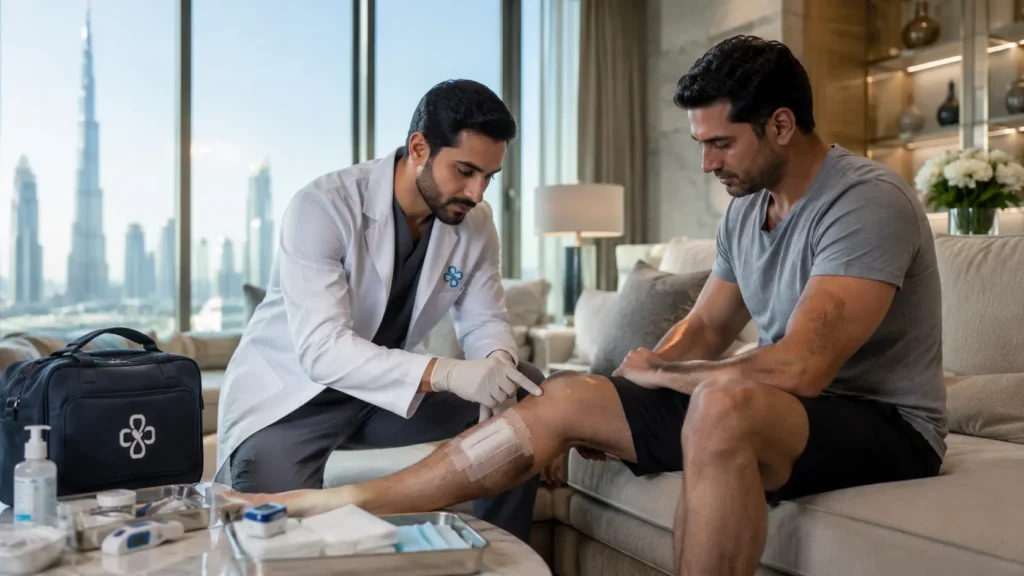
Wound care at home involves cleaning the wound with sterile saline or clean water, applying the appropriate dressing to maintain a moist healing environment, monitoring for signs of infection, and changing the dressing regularly as the wound heals. Most minor cuts, post-surgical incisions, and chronic wounds can be managed safely at home when the correct technique is followed. In Dubai, DHA-licensed nurses are available to perform professional dressing changes at home for complex or high-risk wounds.
Whether you’ve just been discharged after surgery, caring for a family member, or managing a diabetic ulcer, with the right approach, most wounds heal well at home. This guide covers wound types, step-by-step procedure, dressing selection, healing stages, infection warning signs, and when to call a nurse.
Types of Wounds Commonly Managed at Home
Identifying your wound type helps you choose the right level of care.
Minor cuts and lacerations: are shallow skin breaks from accidents or falls. They carry low infection risk when cleaned promptly and heal well with saline cleaning and a non-adherent dressing.
Surgical and post-operative wounds: are incisions closed with sutures, staples, or surgical tape. The main risks are dehiscence (wound opening) and infection at the suture line. Never scrub these, gentle saline irrigation only, following your surgeon’s discharge instructions.
Diabetic foot ulcers and leg wounds develop due to neuropathy and poor circulation. They are often painless, meaning they can worsen unnoticed. Infection risk is extremely high, and these wounds almost always require a DHA-licensed nurse.
Pressure ulcers (bed sores) form at bony prominences in immobile patients. Stage 1–2 can be managed at home with correct positioning and dressings; Stage 3–4 requires clinical assessment.
Minor burns: first-degree (redness, no blisters) and small superficial second-degree burns, can be managed at home. Cool immediately under running water for 10–15 minutes; never use ice, butter, or toothpaste. Any burn larger than the patient’s palm, or on the face, hands, or genitals, requires ER attention.
Basic Wound Care Supplies to Keep at Home
Whether you’re performing simple first aid or following a professional wound care in Dubai treatment plan, good basic wound care starts with the right supplies:
- Sterile saline solution or clean water (for irrigation)
- Disposable non-sterile gloves
- Sterile gauze pads (for cleaning and drying)
- Non-adherent dressings: Mepitel or Adaptic prevent sticking to the wound bed
- Medical tape or bandage roll
- Clean scissors (dedicated wound use only)
- Disposable waste bag for used materials
What NOT to use:
- Hydrogen peroxide damages healthy tissue.
- Iodine directly on the wound, toxic to granulation tissue at home-use concentrations.
- Cotton wool, fibres adhere and cause trauma on removal.
Step-by-Step Wound Care Procedure: How to Clean and Dress a Wound at Home
This is the wound care procedure to follow at every dressing change.
Step 1: Prepare your workspace. Wipe a clean surface with a disinfectant wipe. Lay out all supplies before starting, never reach for items mid-procedure with contaminated gloves.
Step 2: Wash your hands. Soap and warm water for 20–30 seconds, then put on disposable gloves. This is the single most important infection control step.
Step 3: Remove the old dressing. Peel gently from the edges toward the centre. If it sticks, moisten with sterile saline, never pull forcefully. Note the colour, amount, and odour of any wound exudate.
Step 4: Assess the wound. Is it shrinking? Is the wound bed pink or red (healthy granulation tissue) or yellow/black (possible necrotic tissue)? Is the surrounding skin showing redness, warmth, or swelling?
Step 5: Clean the wound. Irrigate gently with sterile saline or clean water, centre outward. Use a fresh piece of gauze for each pass. Do not use hydrogen peroxide or undiluted iodine.
Step 6: Pat dry. Use sterile gauze. Pat, never rub. Surrounding skin must be fully dry before applying adhesive dressings.
Step 7: Apply the new dressing. Choose the correct dressing type (see the table below). Ensure at least 2 cm overlap on all sides and secure with medical tape or a bandage roll.
Step 8: Document and dispose. Note the date, time, wound appearance, and any concerns. Seal used dressings in a waste bag before binning. Wash hands again.
Wound Care Dressings: How to Choose the Right Type
| Wound Condition | Recommended Dressing |
| Minor cut / abrasion | Adhesive bandage or non-adherent gauze |
| Dry wound, little drainage | Hydrogel sheet |
| Moist / weeping wound | Foam dressing (e.g. Mepilex) |
| Heavy drainage | Alginate dressing |
| Fragile skin / post-surgical | Silicone non-adherent (e.g. Mepitel) |
| Infected or high-risk | Antimicrobial / silver-based dressing, nurse to advise |
| Minor burn | Non-adherent dressing + hydrogel |
| Pressure ulcer (Stage 1–2) | Hydrocolloid dressing |
Key principle: Keep the wound moist but not wet, this is moist wound healing, and it speeds epithelialisation (new skin formation) by up to 50% versus leaving wounds exposed to air.
Change dressings: daily for minor wounds; every 24–48 hours for post-surgical wounds (or per surgeon’s instructions); as nurse-prescribed for diabetic ulcers and pressure sores.
Signs of Wound Infection: When Home Care Is No Longer Enough
Call a nurse, don’t wait, if you notice:
- Redness spreading from the wound edges
- New or worsening swelling and warmth
- Pus or cloudy discharge (yellow, green, or thick)
- Foul or unusual odour
- Pain increasing rather than improving after day 2–3
- Wound not visibly shrinking after 7 days
Go to A&E or call 999 immediately if:
- Fever above 38°C alongside wound symptoms
- Red streaks spreading outward (signs of cellulitis)
- Wound opening, or tissue appearing black or dark (necrosis)
- Significant bleeding that won’t stop with pressure
- Signs of systemic infection, confusion, rapid heart rate, severe chills
Dubai note: During the humid summer months (May–September), sweat and humidity can compromise dressings faster. Check wounds more frequently and change dressings sooner if they become wet or loosened. Because infection can develop quickly in certain wounds, patients should seek medical advice if symptoms worsen. A Doctor On Call Dubai service can assess the wound at home, recommend appropriate treatment, and determine whether additional medical care is required.
If you notice any warning signs, 800DOCTOR’s DHA-licensed nurses can perform a professional wound assessment and provide expert wound care in Dubai at your home, often within a few hours of booking, often within a few hours of booking.
The 4 Stages of Wound Healing, and How to Tell It’s Working
Stage 1 Haemostasis (minutes to hours). Blood clots to stop bleeding; a scab begins forming. Apply gentle pressure and don’t disturb the clot.
Stage 2 Inflammation (days 1–5). White blood cells clean the wound. Redness, swelling, warmth, and mild pain are normal, not infection.
Stage 3 Proliferation (days 4–24). Granulation tissue fills the wound, pink or red moist tissue, and it gets visibly smaller. Maintain moisture with appropriate dressings.
Stage 4 Remodelling (weeks to months). The wound closes, scar tissue forms, and new skin strengthens. Protect from sun; gentle massage may reduce scarring, ask your nurse.
If the wound is not progressing from Stage 2 to Stage 3 within 7–14 days, seek professional assessment. Chronic non-healing wounds need specialist evaluation.
What to Eat for Faster Wound Healing
Protein rebuilds tissue, including chicken, fish, eggs, legumes, or dairy at every meal. Requirements increase significantly after surgery or injury.
Vitamin C drives collagen synthesis. Sources: citrus fruits, bell peppers, kiwi, broccoli. Deficiency noticeably slows healing.
Zinc supports immune function and tissue regeneration. Sources: meat, shellfish, pumpkin seeds, legumes. Discuss supplementation with your doctor.
Hydration, cells cannot repair without adequate fluid. Dubai’s heat makes dehydration more likely, especially in summer when wound infection risk is elevated. In some cases, patients recovering from illness or surgery may be advised by a healthcare professional to receive IV drip therapy at home to support hydration and recovery.
When to Call a Wound Care Nurse vs. Go to the Emergency Room
Call a DHA-licensed nurse at home (800DOCTOR) when:
- Wound dressing is complex or you feel uncertain about technique
- The wound is a diabetic ulcer, pressure sore, or post-surgical incision
- You notice early infection signs, increased redness, discharge, or mild odour
- The wound is not improving after 7 days of home care
- The patient has limited mobility or cannot travel to a clinic
- Suture removal is needed (a nurse can do this at home)
Go to A&E or call 999 when:
- Fever above 38°C with wound symptoms
- Red streaks spreading from the wound
- Severe uncontrolled bleeding
- Suspected wound dehiscence (surgical wound opening)
- Signs of systemic infection, confusion, rapid breathing
- Worsening wounds on the face, hands, or genitals
800DOCTOR’s DHA-licensed nurses provide professional wound care in Dubai at your home, hotel, or office 24/7, including dressing changes, wound assessment, suture removal, and infection monitoring.
Frequently Asked Questions About Wound Care at Home
How often should I change a wound dressing at home?
Minor wounds need a change once daily, or sooner if the dressing becomes wet, dirty, or loose. Post-surgical wounds follow your surgeon’s instructions, typically every 24–48 hours. Diabetic ulcers and pressure sores may need more frequent changes on a nurse-prescribed schedule.
Should I let a wound dry out and breathe without a dressing?
No. Modern wound care recommends keeping wounds covered and slightly moist rather than letting them dry out. Moist wound healing can speed recovery by up to 50%, reduce scarring, and support healthier tissue repair while also lowering the risk of infection and wound cracking.
Can I shower with a wound?
For most minor wounds, brief showering is fine if the dressing is waterproof or replaced immediately afterward. Surgical wounds should not be submerged, no baths, pools, or sea, until fully closed and confirmed by your doctor.
How do I know if my wound is infected or just healing normally?
Normal healing involves redness, warmth, and mild swelling for the first 3–5 days. Infection is indicated by redness that is spreading, increasing pain after day 3, pus, foul odour, and fever. When in doubt, call a nurse for assessment rather than waiting.
Can a nurse perform wound dressing at home in Dubai?
Yes. DHA-licensed nurses can perform wound assessment, dressing changes, infection monitoring, and post-surgical wound care at home.
How quickly can I book wound care in Dubai?
Home nursing visits are available across Dubai, often on the same day depending on availability.
Medical Review & Clinical Accuracy
This article has been reviewed by DHA-licensed healthcare professionals at 800DOCTOR to ensure the information reflects current wound care best practices and patient safety guidelines. The content is provided for educational purposes only and should not replace professional medical advice, diagnosis, or treatment. Individual care recommendations may vary based on a patient’s condition and medical history.
Need Professional Wound Care at Home in Dubai?
Managing a wound at home is achievable with the right knowledge, but some wounds need professional hands. If you require expert wound care in Dubai, 800DOCTOR’s DHA-licensed nurses are available 24/7 for home visits: dressing changes, wound assessment, suture removal, and infection monitoring across Dubai.